Want to open, close and check your garage door from your phone? Smart garage door installation in Central Coast homes lets you control the door through an app over Wi-Fi, whether you already have an opener or you’re putting in a new one.
Most people start with the same question. Can my current opener be made smart, or do I need to replace it? The answer depends on the opener already fitted to your door.
On this page we explain the difference between a retrofit and a new smart opener. We cover how compatibility is checked, the safety features a smart setup should have, and what happens if the power or internet drops out.
This service is part of our wider work as a garage door supplier.
If you’re not sure which option you need, get in touch and we can check what your current opener supports.
There are two ways to get app control over your garage door.
The first is a retrofit. A smart hub or controller is added to the opener you already have, so the existing motor keeps doing the work. Many existing openers can generally be made smart this way, depending on whether the unit is compatible.
The second is a new smart-enabled opener. This is typically needed when the existing opener is not compatible with a retrofit controller.
Compatibility depends on things like the age of the opener, whether it has a “Learn” button, and how well Wi-Fi reaches the garage. We go through those checks in the next section.
Both options sit within the same service. We install retrofit smart controllers and new smart-enabled openers. What we don’t cover here is standard motorisation without smart control, or general garage door repairs.
Once we know which opener you have, we can tell you which path suits your garage.
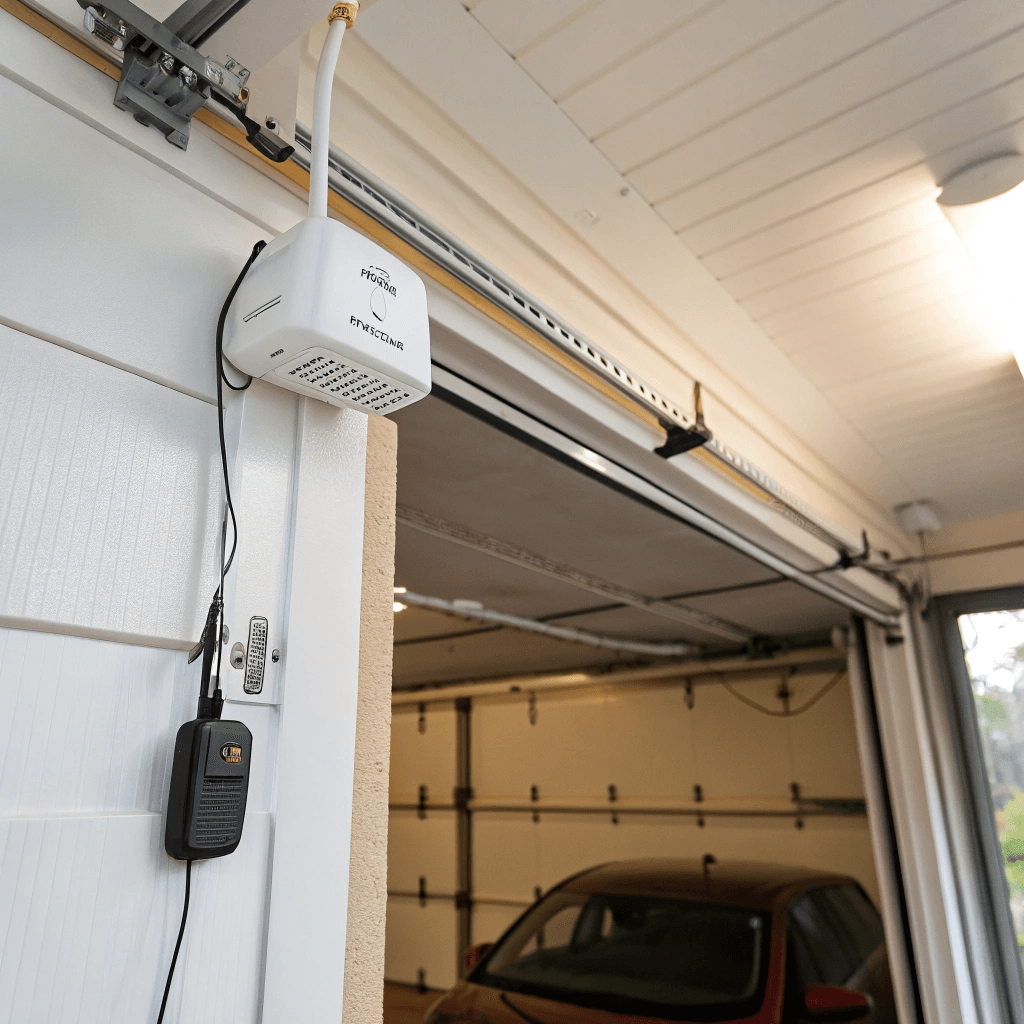
Compatibility is not a guess. It comes down to a few practical checks on the opener already fitted in your garage.
A retrofit generally needs a newer opener model. One of the clearest signs is a “Learn” button on the motor unit, usually found near the aerial or behind a light cover. Openers made before 1993 typically fall outside what retrofit controllers support.
Wi-Fi reach matters just as much. Smart controllers run on a 2.4GHz signal, so the garage needs reliable coverage from your router. A weak or patchy signal can affect how the system performs day to day.
We also check whether safety sensors are fitted. These are part of the assessment because smart control means the door can be operated when nobody is standing nearby.
The hardware around the door gets a look as well. Coastal humidity and salt exposure can accelerate wear on external hardware components over time, so we check the condition of what we’re working with.
If the opener doesn’t meet these checks, a retrofit may not be possible and replacement with a smart-capable unit may be the better option.
Some smart installations involve electrical wiring work. Where they do, that work must be carried out by a licensed electrician.
In NSW, any electrical wiring work requires a licensed electrician, no matter how small the job is. There’s no exemption for quick or minor work.
A Certificate of Compliance for Electrical Work also applies to relevant wiring jobs. This is the document that records the work was done by a licensed person and meets the required standard.
This applies specifically where hardwired connection work is involved in the installation.
You can check the licensing requirement yourself on the NSW Fair Trading website.
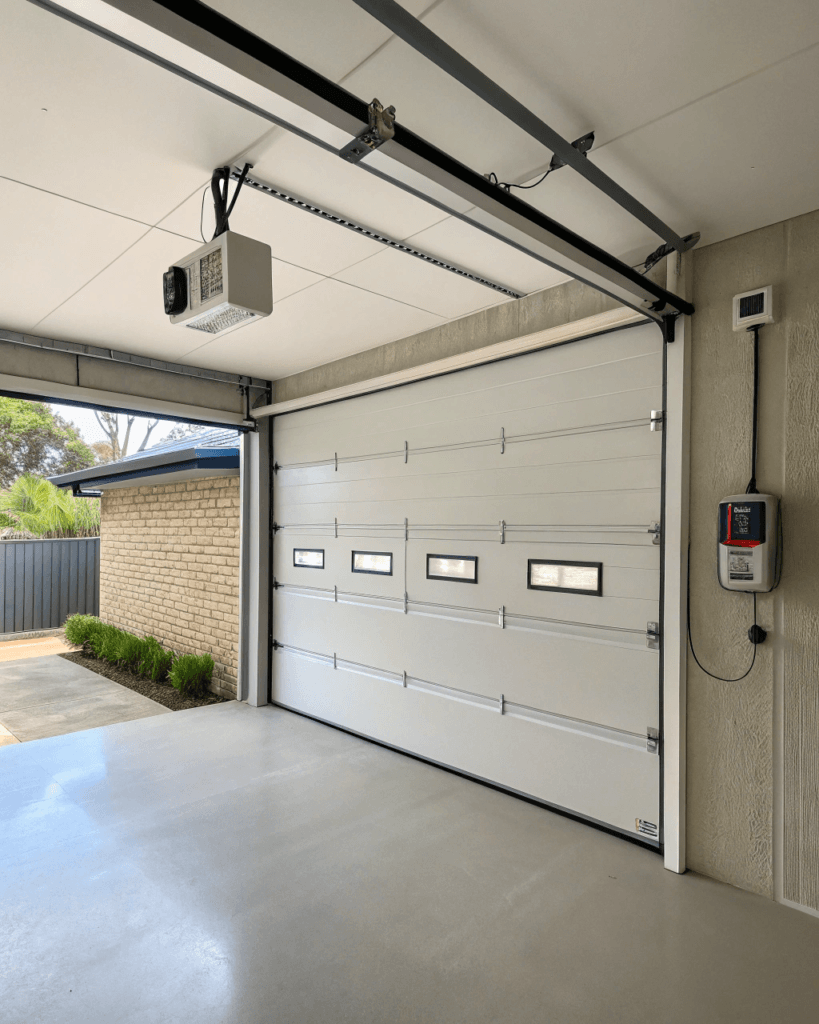
A smart opener still has to meet the same safety expectations as any automatic door drive system.
Auto-reverse entrapment protection is a required safety mechanism. If the door meets resistance while closing, it must stop and reverse rather than keep pushing down.
Monitored infrared safety beams apply to smart-controlled operation. Because a smart door can be opened or closed when nobody is watching it, the beams across the doorway detect anything in the path and stop the door.
These requirements sit under the relevant Australian and New Zealand standard for automatic door drive systems, AS/NZS 60335.2.95.
If you’re adding app control to an existing opener, these are the features we check during the assessment.
Outages are worth thinking about before you commit to a smart setup.
A garage door opener will not operate during a power outage unless a battery backup is fitted. Without one, the motor has nothing to run on.
The manual release is your way in and out. Pulling the emergency release cord disconnects the door from the motor so you can lift it by hand.
An internet or Wi-Fi outage is a different situation. The power may still be on and the opener still works, but app control will not. A wall button or remote can still operate the door in that case.
This matters on the Central Coast. Storm, bushfire and heatwave events have caused documented power and telecommunications outages across the region. A 2025 coastal storm event affected more than 40,000 customers, and an earlier local storm outage affected around 3,600.
If outage preparedness is a concern for you, mention it when you contact us and we can factor battery backup into the setup.
This is usually the last question people ask before going ahead.
On the convenience side, remote monitoring and control are the main draw. You can check whether the door is closed from your phone without driving home, and open it for someone while you’re out.
The trade-off is dependency. Smart control generally relies on cloud servers and an app, so if connectivity fails, that layer of control drops away. The door itself can still be operated another way, but the convenience you paid for isn’t there at that moment.
Wi-Fi signal strength at the garage affects this day to day. Garages often sit at the edge of home network coverage, and a weak signal can make the app slow or unreliable.
Whether it’s worth it depends on how much you value remote control and how solid your connection is at the garage. If you’d like to talk it through, get in touch and we can look at your setup.




Many existing openers can generally be made smart with a retrofit hub or controller, depending on whether the unit is compatible. Compatibility comes down to things like the age of the opener, whether it has a “Learn” button, and Wi-Fi reach at the garage. If the opener isn’t compatible, replacement with a smart-capable unit may be needed instead.
Two things generally matter. The garage needs adequate power access for the opener, and it needs a reliable Wi-Fi signal so the app can talk to the controller. Garages often sit at the edge of home network coverage, so signal strength is worth checking before you book.
Where electrical wiring work is involved, yes. In NSW, electrical wiring work must be carried out by a licensed electrician, regardless of the size of the job. A Certificate of Compliance for Electrical Work applies to relevant wiring jobs.
In a power outage, the opener will not run unless a battery backup is fitted. The manual release remains available so you can operate the door by hand. If the internet or Wi-Fi drops but power stays on, app control will not work, though the door can still be operated another way. This is worth planning for on the Central Coast, where storm, bushfire and heatwave events have caused documented power and telecommunications outages.
Auto-reverse entrapment protection is a required safety mechanism, so the door stops and reverses if it meets resistance while closing. Monitored infrared safety beams apply to smart-controlled operation, since the door can be operated when nobody is nearby. Both sit under AS/NZS 60335.2.95, the standard for automatic door drive systems.
It depends on how you’d use it. Remote monitoring and control are genuinely convenient, particularly for confirming the door is closed when you’re away from home. The trade-off is that app control relies on connectivity, and Wi-Fi signal at the garage can affect how reliable it feels day to day.
Looking for garage doors near me? Follow these simple directions to find us from anywhere in NSW!